
Renogy 2000W Pure Sine Wave Inverter Review | The Backbone of Our Vanlife Electrical System After 5 Years
This post may contain affiliate links. As full time travelers and outdoor adventurers, we only recommend products we personally use and trust. If you purchase through one of our links, we may earn a small commission at no additional cost to you.

Introduction
When people ask about our van electrical system, most of the questions revolve around batteries and solar panels.
Those are certainly important.
But there’s another component that quietly makes the entire system usable every single day.
The inverter.
Without it, all the power stored in your batteries is essentially trapped in a format that most household electronics can’t use.
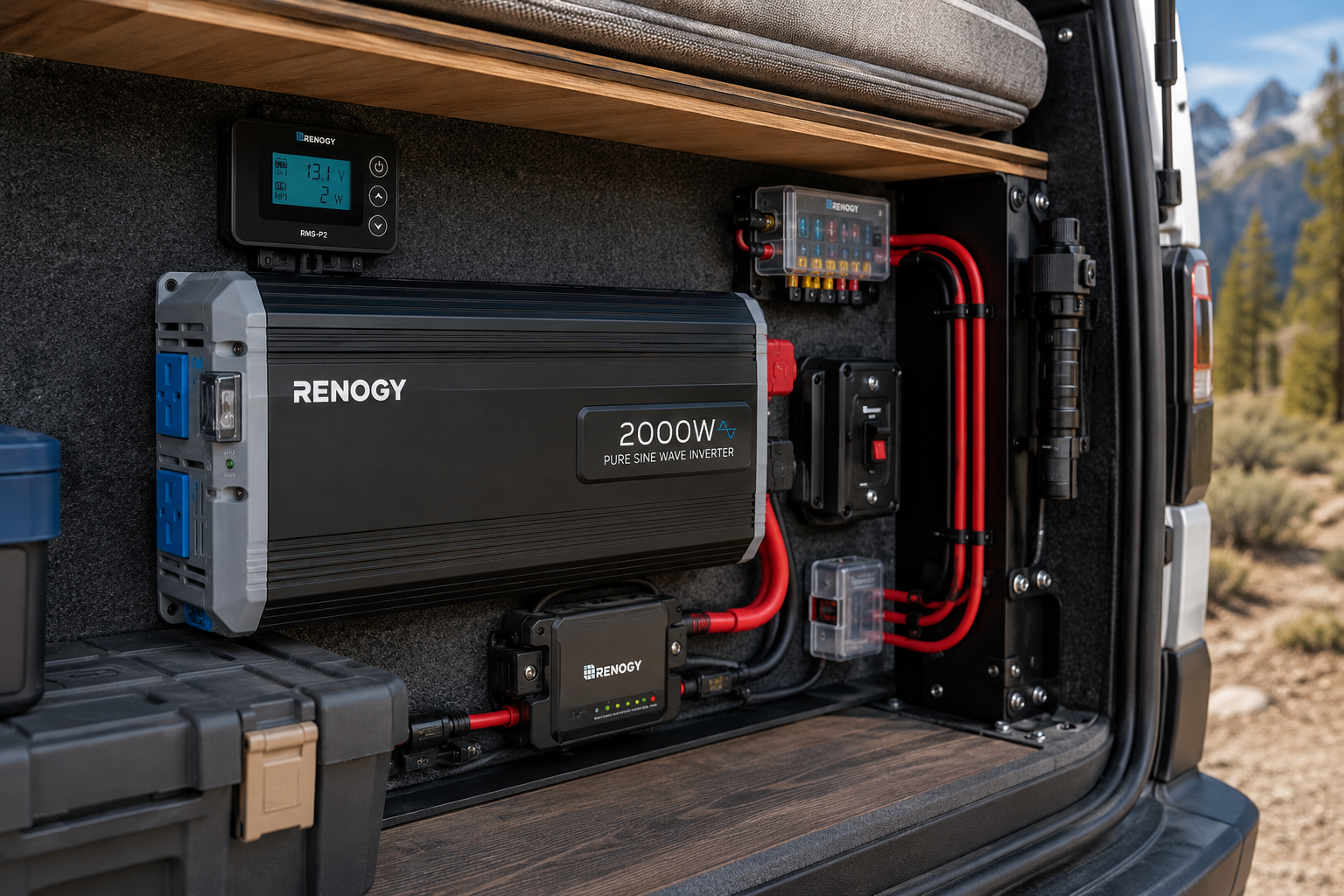
For the past five years, our Renogy 2000W Pure Sine Wave Inverter has been the bridge between our battery bank and the devices we rely on every day while living full time on the road.
It has powered laptops during workdays, charged camera batteries after long adventures, run kitchen appliances, powered Starlink, supported content creation, and generally done its job without ever demanding attention.
After thousands of miles across the Rockies, Mountain West, Pacific Northwest, Desert Southwest, and beyond, it remains one of the most reliable pieces of equipment in our van.
If you’re building a van, upgrading an RV, planning an off grid power system, or researching the best pure sine wave inverter for travel and remote work, here’s my real world experience with the Renogy 2000W Inverter.
What Does an Inverter Actually Do?
Before diving into the review, it’s worth understanding why an inverter is so important.
Your batteries store power as 12V DC electricity.
Most household devices require 110V AC electricity.
An inverter converts battery power into usable household power.
That means you can run:
Laptops
Camera chargers
Drone batteries
Monitors
Small kitchen appliances
Starlink
Lighting systems
Power tools
Battery charging stations
Without an inverter, many of the devices that make vanlife comfortable simply wouldn’t work.
Five Years of Full Time Vanlife Testing
The biggest compliment I can give this inverter is that I rarely think about it.
That may sound strange.
But when it comes to critical electrical components, being forgettable is actually a good thing.
Over the last five years, this inverter has quietly powered our daily lives while we traveled throughout North America.
It has survived:
High elevation winters
Desert heat
Humid summer storms
Thousands of miles of rough roads
Constant vibration
Full time use
And through all of it, it continues to operate exactly as it did when it was first installed.
I’ve never had a failure.
I’ve never had a major issue.
I’ve never had to replace it.
That level of reliability matters when your home depends on it.
Why Pure Sine Wave Matters
One of the biggest reasons I chose this inverter was the pure sine wave design.
Some cheaper inverters use modified sine wave output.
While those systems can work for basic applications, sensitive electronics often perform better and more safely with pure sine wave power.
That includes devices like:
Computers
Camera charging systems
Drone batteries
Starlink equipment
Monitors
Professional electronics
Because we work remotely and create content full time, clean power is incredibly important.
The Renogy has consistently delivered stable, reliable power for every piece of equipment we use.
The Remote Switch Is More Useful Than Most People Realize
One feature I underestimated during the build process was the included remote controller.
At first, it seemed like a nice convenience.
Today, it’s something I would absolutely prioritize again.
The remote allows you to mount the inverter in a practical location while maintaining easy control access elsewhere in the van.
This creates much more flexibility during installation.
Instead of designing your entire electrical cabinet around inverter accessibility, you can place the inverter where it makes the most sense and control it remotely.
For daily vanlife use, that convenience adds up quickly.
What We Actually Power With It
Our inverter sees daily use.
Over the years, we’ve used it to power:
Laptop computers
Camera battery chargers
Drone charging systems
Starlink internet
Small kitchen appliances
Lighting equipment
Content creation gear
USB charging stations
Portable power devices
One of the things I appreciate most is that it simply works in the background.
Whether we’re editing videos from a mountain town, working remotely from a forest service road, or charging batteries after a long day outside, power is always available.
Pairing It with Solar
Our van runs a 600 watt Renogy solar setup paired with lithium batteries.
Together, this combination has been incredibly capable.
The solar system generates the power.
The batteries store it.
The inverter makes it usable.
It’s easy to focus on solar panels because they’re visible.
But without a quality inverter, the system wouldn’t deliver the same experience.
For us, the Renogy inverter has been an essential part of making off grid living comfortable and sustainable.
What Most Reviews Miss
Most inverter reviews focus heavily on technical specifications.
Wattage.
Efficiency.
Surge ratings.
Those things matter.
But after years of real world use, what matters most is reliability.
Can you trust it?
Can you forget about it?
Will it work when you need it?
The Renogy passes all three tests.
It isn’t flashy.
It doesn’t demand attention.
It simply provides dependable power day after day.
That’s exactly what you want from a critical electrical component.
Durability and Long Term Ownership
One thing that has impressed me is how well the inverter has handled the realities of life on the road.
Vanlife is hard on equipment.
Constant vibration.
Temperature swings.
Dust.
Humidity.
Road impacts.
Despite all of that, this inverter continues to perform.
After five years, it remains one of the most dependable pieces of equipment in our electrical system.
That kind of long term durability adds tremendous value.
Pros and Cons
Pros
Proven reliability after five years
Pure sine wave output
Excellent for sensitive electronics
Helpful remote controller
Flexible installation options
Handles daily use with ease
Great for remote work setups
Pairs well with solar systems
Quiet operation
Cons
Larger than smaller inverters
Installation requires proper wiring knowledge
Premium price compared to modified sine wave models
Can consume standby power if left on unnecessarily
Renogy 2000W Inverter vs Smaller Inverters
A lot of people building vans debate between 1000W and 2000W systems.
For basic charging needs, 1000W may be enough.
But if you’re running:
Kitchen appliances
Starlink
Multiple computers
Professional electronics
Higher demand devices
The additional capacity of a 2000W inverter creates much more flexibility.
For full time travel, I believe the 2000W category hits a great balance between capability and efficiency.
Who This Inverter Is Best For
This inverter is ideal for:
Vanlifers
RV owners
Off grid travelers
Remote workers
Digital nomads
Content creators
Overlanders
Tiny home owners
Solar power enthusiasts
Weekend adventurers

Final Verdict
After five years of full time vanlife, the Renogy 2000W Pure Sine Wave Inverter has proven itself to be one of the most reliable pieces of equipment in our entire build.
It has powered countless workdays, adventures, road trips, and remote campsites.
The remote controller makes daily use incredibly convenient.
The pure sine wave output protects sensitive electronics.
And the overall reliability has been exceptional.
If you’re building a van, RV, cabin, or off grid solar setup and want an inverter you can trust for the long haul, the Renogy 2000W remains one of the easiest recommendations I can make.
It’s not the most exciting piece of gear in our van.
But it’s absolutely one of the most important.
Frequently Asked Questions
Is the Renogy 2000W inverter worth it?
Yes. After five years of full time use, it has proven extremely reliable and capable for vanlife, RV travel, and off grid living.
What can a 2000W inverter run?
A 2000W inverter can power laptops, chargers, Starlink, small appliances, lighting systems, and many common household devices.
Is pure sine wave better than modified sine wave?
For sensitive electronics such as computers, camera gear, and communication devices, pure sine wave power is generally preferred.
Can this inverter be used with solar panels?
Absolutely. It works exceptionally well as part of a solar powered electrical system.
Is 2000W enough for vanlife?
For most vanlife setups, yes. A quality 2000W inverter provides enough capacity for everyday power needs while maintaining good efficiency.
