
This post may contain affiliate links. As full time travelers and content creators, we only recommend products we personally use and trust. If you purchase through one of our links, we may earn a small commission at no additional cost to you.
Introduction
Every content creator eventually reaches a point where storage becomes a problem.
It starts innocently enough. A few drone clips here. A couple of GoPro videos there. Some travel photos from a weekend trip. Before long, you’re managing terabytes of footage and wondering where all your available storage disappeared.
For us, that realization happened somewhere between editing YouTube videos from mountain towns, backing up drone footage from remote campsites, and trying to organize years of travel content collected across North America and beyond.
That’s where the Samsung T7 entered the picture.
Over the past several years, it has become one of my favorite pieces of technology for travel, remote work, and content creation. It is incredibly small, surprisingly durable, insanely fast, and dependable in a way that traditional hard drives simply cannot match.
While I still use larger external drives for long term archiving, the Samsung T7 has become my go to solution whenever speed, portability, and convenience matter most.
If you’re looking for the best portable SSD for travel, vanlife, photography, videography, remote work, or content creation, this drive deserves a place at the top of your list.
Why I Switched to SSD Storage
For years I used traditional hard drives.
They worked fine.
Until they didn’t.
Traditional hard drives contain moving parts. While they can offer a lot of storage capacity, they are inherently more vulnerable to drops, vibration, and the realities of life on the road.
When you spend your life traveling through the Rockies, working from campsites in the Desert Southwest, or editing videos from the front seat of a van, durability becomes a major consideration.
The Samsung T7 solved that problem.
Because it is a solid state drive, there are no moving parts inside. That immediately makes it more resilient and more dependable for travel based workflows.
Once I experienced the speed improvements and peace of mind that came with SSD storage, it became very difficult to go back.
The Perfect Size for Travel
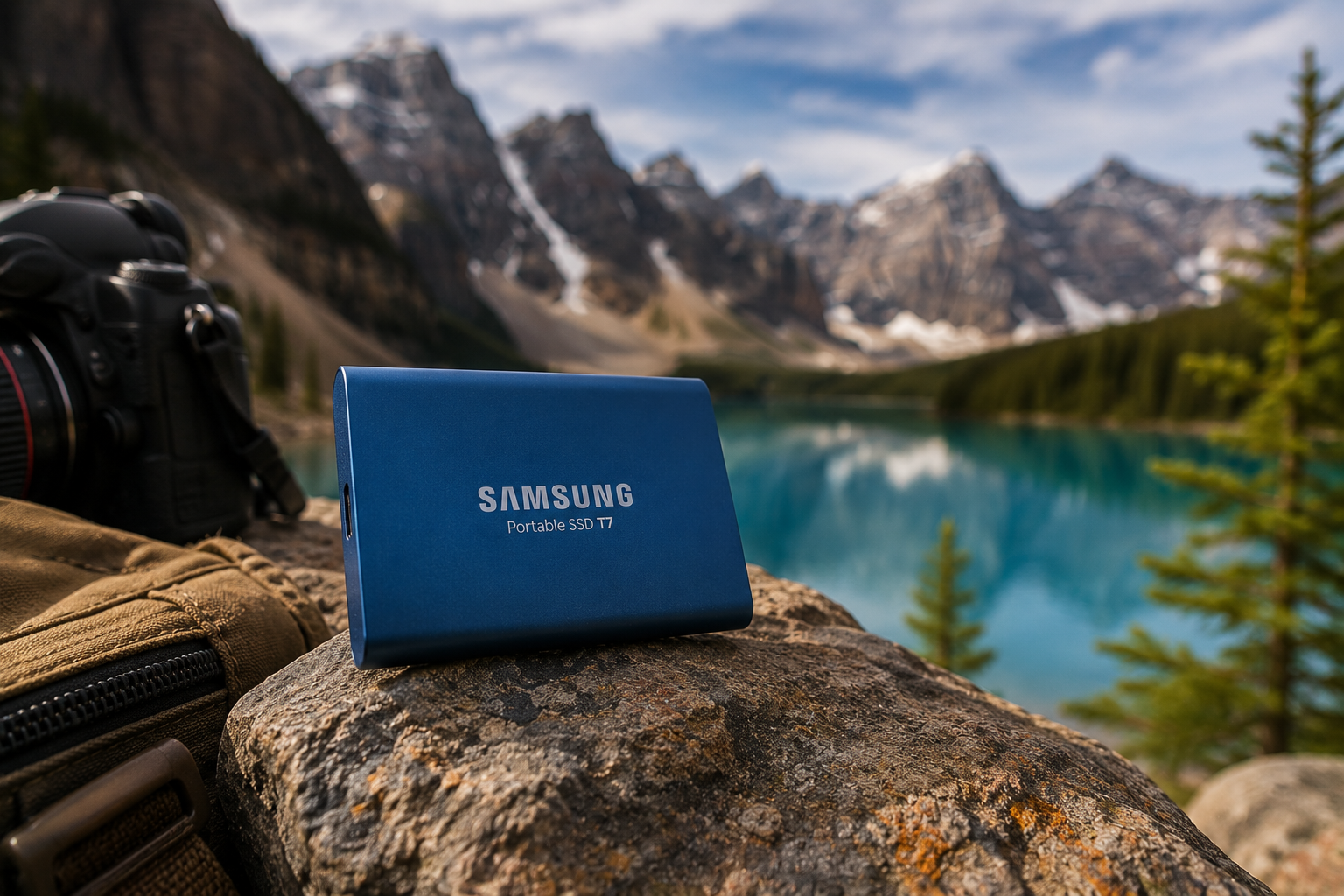
One of my favorite things about the Samsung T7 is how ridiculously compact it is.
The drive is roughly the size of a credit card and easily slips into a pocket, backpack organizer, camera cube, or laptop sleeve.
When you’re constantly moving between campsites, coffee shops, coworking spaces, airport terminals, and mountain towns, minimizing bulk becomes incredibly valuable.
Some storage solutions feel like an additional piece of gear.
The T7 practically disappears.
I often forget it is even in my bag until I need it.
That level of portability makes it perfect for travel creators, digital nomads, photographers, videographers, and anyone who works remotely.
The Transfer Speeds Are Insane
The first time I transferred footage onto the Samsung T7, I honestly thought something was wrong.
Files were moving so quickly that it felt almost impossible compared to the traditional hard drives I had been using.
When you’re regularly working with:
• 4K video files
• Drone footage
• Photography libraries
• Client projects
• YouTube content
• Podcast recordings
• Travel archives
Every minute saved during transfers adds up.
The T7 dramatically speeds up my workflow.
Whether I’m backing up footage from a weekend adventure or editing a full YouTube project, the drive never feels like the bottleneck.
That alone makes it worth carrying.
Built for Life on the Road
Most technology reviews happen at a desk.
My experience with the Samsung T7 has been very different.
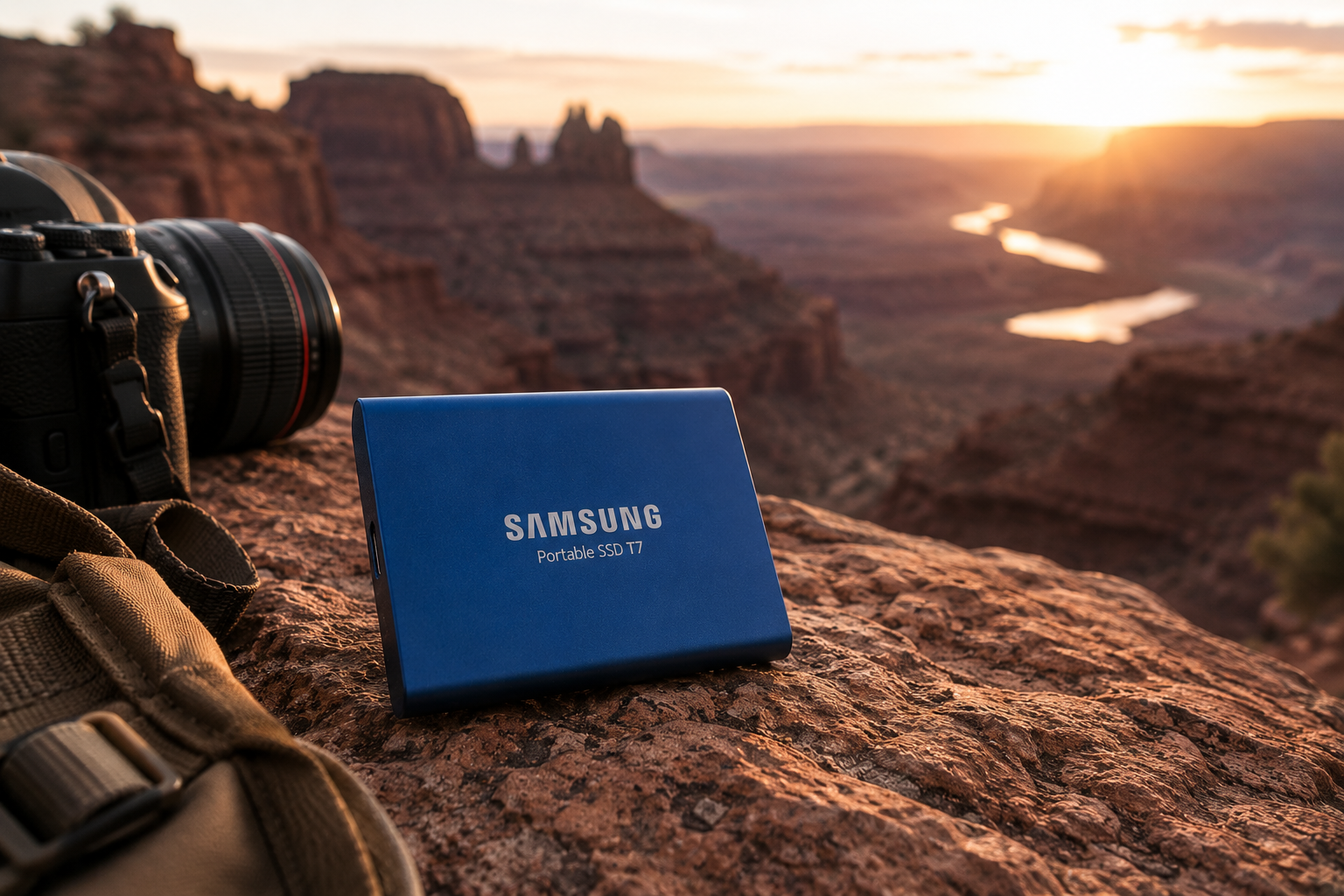
This drive has traveled through the Mountain West, Pacific Northwest, Desert Southwest, Canadian Rockies, and countless road trips in between.
It has lived inside backpacks.
It has been tossed into camera bags.
It has ridden thousands of miles inside our van.
And despite all of that, it continues to perform flawlessly.
The aluminum construction feels premium while also providing confidence when traveling. It is not marketed as an ultra rugged adventure drive like some competitors, but its SSD architecture gives it a level of resilience that traditional hard drives simply cannot match.
For travelers and outdoor content creators, that matters.
Why It Has Become My Remote Work Drive
One of the biggest advantages of the T7 is how seamlessly it fits into a mobile work setup.
When I’m working remotely, space is always limited.
Coffee shop tables are small.
Van workstations are compact.
Airport lounges are crowded.
The Samsung T7 excels in those environments.
Its tiny footprint means it never gets in the way, and its performance means I can work directly from the drive without noticing any slowdown.
For remote workers, digital nomads, and travel creators, that combination is incredibly valuable.
Comparing the Samsung T7 to Traditional Hard Drives
The biggest difference comes down to confidence.
Traditional hard drives often make me think twice before tossing them into a backpack.
The Samsung T7 doesn’t.
Its lack of moving parts creates a level of reliability that feels much better suited for travel.
Traditional hard drives still offer advantages when it comes to maximum storage capacity and long term archival solutions.
But for active projects, content creation, travel, and remote work, the Samsung T7 is usually the first drive I reach for.
What Most Reviews Miss
Most reviews focus heavily on benchmark numbers.
Transfer speeds matter, but they are only part of the story.
What really stands out about the T7 is how frictionless it makes everything.
It removes obstacles.
It simplifies travel.
It reduces setup complexity.
It speeds up workflows.
It becomes one less thing to worry about.
The best gear often disappears into the background and simply helps you do what you love.
The Samsung T7 is one of those products.
Pros and Cons
Pros
• Extremely compact and portable
• Outstanding transfer speeds
• More reliable than traditional hard drives
• No moving parts
• Perfect for travel and remote work
• Lightweight and easy to carry
• Excellent build quality
• Great for content creation workflows
Cons
• More expensive per terabyte than traditional HDDs
• Smaller maximum capacities compared to large archive drives
• Can be easier to misplace due to compact size
Who This Drive Is Best For
The Samsung T7 is an excellent fit for:
• YouTubers
• Photographers
• Videographers
• Digital nomads
• Remote workers
• Vanlifers
• Travel creators
• Drone pilots
• Outdoor adventurers
• Business travelers
Final Verdict
After years of travel, remote work, and content creation, the Samsung T7 has become one of my favorite storage devices I’ve ever owned.
Its combination of speed, portability, durability, and reliability makes it incredibly difficult to beat.
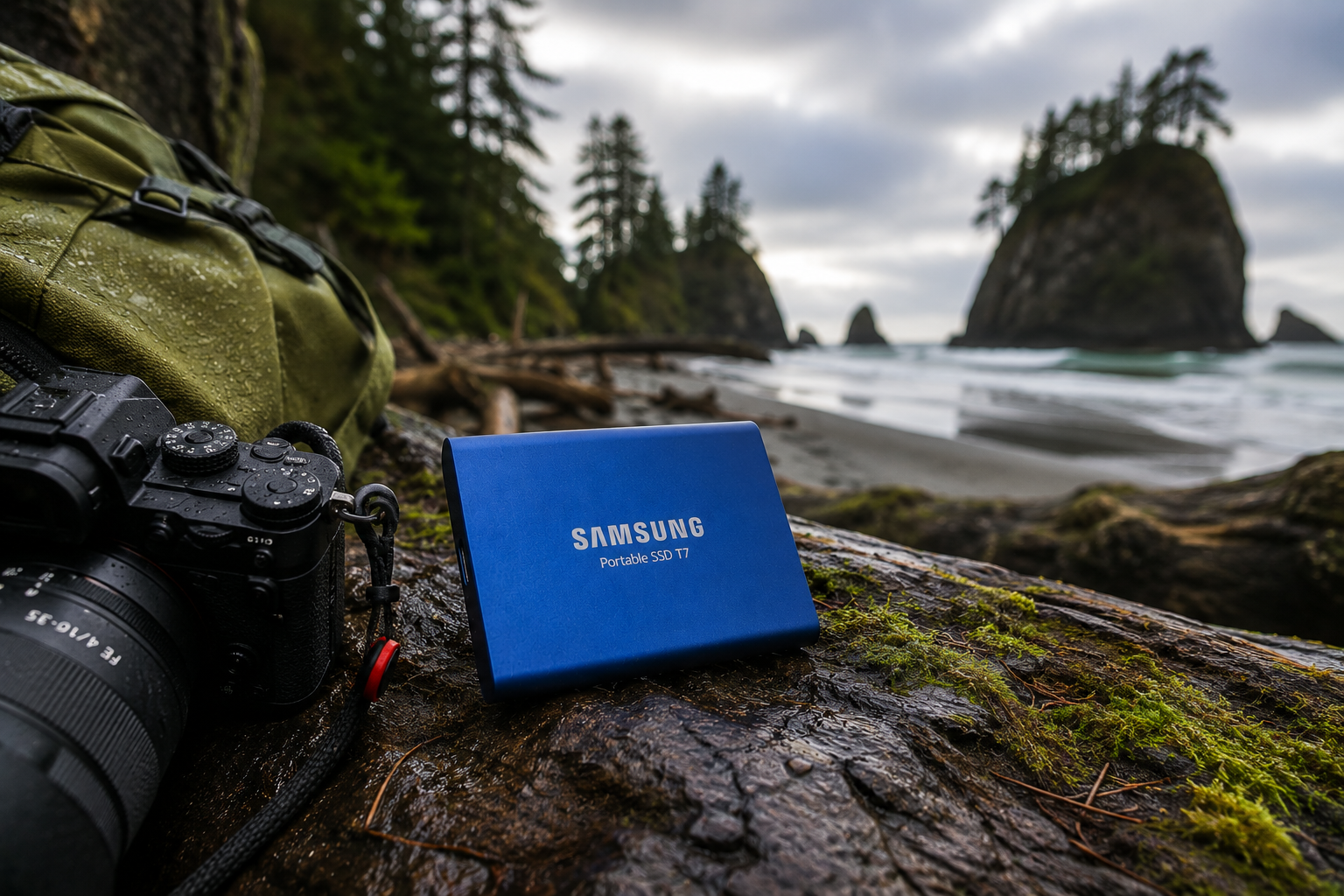
The credit card sized footprint means it can go anywhere. The SSD architecture provides confidence when traveling. And the transfer speeds dramatically improve daily workflows.
While traditional hard drives still have a place for large scale archives, the Samsung T7 is the drive I consistently reach for when I need dependable storage on the move.
If you’re searching for one of the best portable SSDs for travel, vanlife, content creation, photography, videography, or remote work, the Samsung T7 is absolutely worth considering.
In fact, I’ll probably keep buying more of them.
Frequently Asked Questions
Is the Samsung T7 good for video editing?
Yes. The Samsung T7 offers fast transfer speeds and excellent performance for editing video projects, including 4K footage.
Is the Samsung T7 worth it?
For content creators, travelers, photographers, videographers, and remote workers, absolutely. The portability and performance are excellent.
Is the Samsung T7 better than a traditional hard drive?
Can the Samsung T7 survive travel?
Yes. While it is not marketed as a rugged adventure drive, the SSD architecture makes it far more resilient than traditional HDDs.
